

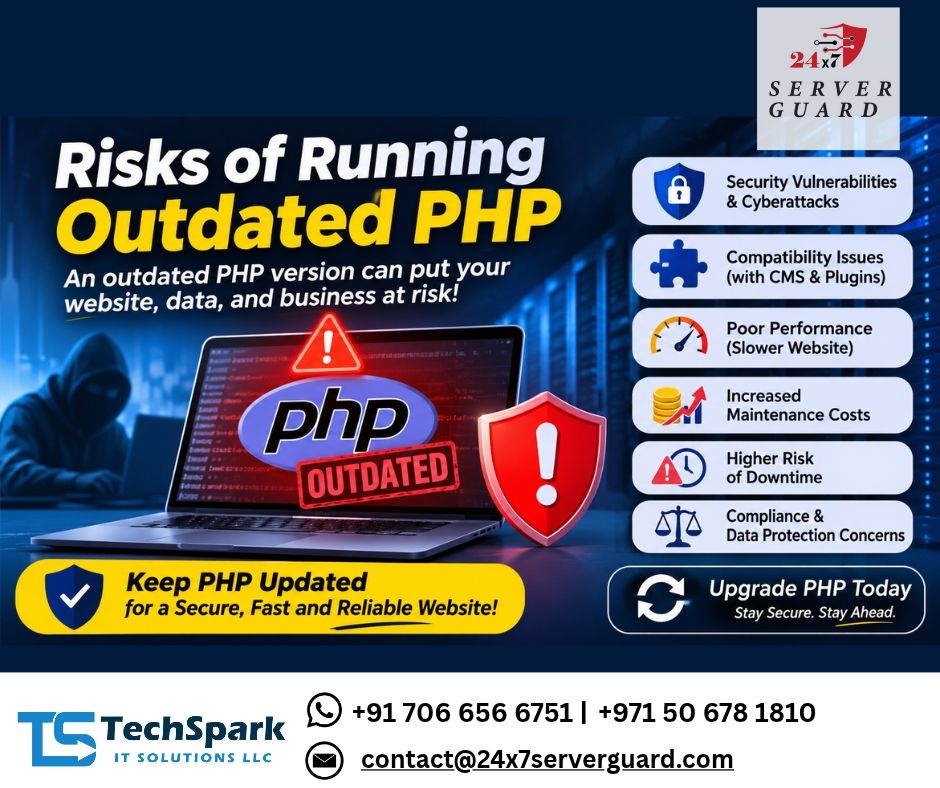
Running an outdated PHP version can expose websites and applications to serious security, performance, and compatibility issues. Many businesses continue using older PHP versions because their existing applications appear to work normally. However, an outdated PHP environment can become a significant operational risk over time.
Here are the major risks businesses should understand.
3.1 Security Vulnerabilities and Cyberattacks
Older PHP versions that have reached End-of-Life (EOL) no longer receive regular security updates from the PHP development team. This means newly discovered vulnerabilities may remain unpatched.
Potential threats include:
- Remote code execution (RCE).
- SQL injection risks through vulnerable applications.
- Cross-site scripting (XSS).
- Privilege escalation.
- Exploitation of known software vulnerabilities.
Business impact: Attackers may exploit vulnerable applications, potentially resulting in data breaches, website compromise, malware infections, or unauthorized server access.
3.2 Website Compatibility Issues
Modern applications, CMS platforms, plugins, and frameworks increasingly require supported PHP versions.
Running outdated PHP may result in:
- WordPress plugin and theme incompatibility.
- Laravel and Symfony framework compatibility issues.
- Deprecated functions and unsupported extensions.
- Application errors and unexpected behavior.
- Failed software installations or upgrades.
Business impact: Websites may stop functioning correctly, limiting the ability to introduce new features, integrate services, or maintain applications.
3.3 Poor Website Performance
Newer PHP releases introduce performance improvements, optimizations, and better resource management.
Outdated PHP versions may result in:
- Slower application execution.
- Inefficient memory utilization.
- Increased CPU consumption in certain workloads.
- Slower database-driven operations.
- Reduced scalability during traffic spikes.
Business impact: Slow-loading websites can negatively affect customer experience, conversion rates, and overall business performance.
3.4 Increased Server Maintenance Costs
Maintaining legacy PHP environments can become increasingly difficult as hosting infrastructure evolves.
Common challenges include:
- Additional compatibility work.
- Dependency on legacy extensions.
- Limited vendor and community support.
- More complicated troubleshooting.
- Increased engineering and maintenance effort.
Business impact: Businesses may spend more time and money maintaining outdated environments instead of investing in infrastructure improvements.
3.5 Higher Risk of Website Downtime
Outdated PHP environments can create operational challenges during server upgrades, application deployments, and software migrations.
Unexpected incompatibilities can cause:
- HTTP 500 Internal Server Errors.
- Broken website functionality.
- Failed application deployments.
- Unavailable plugins or extensions.
- Unexpected application crashes.
Business impact: Website downtime can lead to lost revenue, interrupted business operations, and reduced customer trust.
3.6 Compliance and Data Protection Concerns
Organizations handling sensitive customer information must maintain appropriate security controls.
Running unsupported software can make it harder to demonstrate effective vulnerability management and security maintenance.
Depending on the applicable regulatory framework, this may affect:
- PCI DSS security requirements.
- GDPR security obligations.
- HIPAA security safeguards.
- Internal information security policies.
Business impact: Unsupported PHP versions can contribute to security and compliance gaps, potentially increasing regulatory and operational risks.
Why Businesses Should Upgrade PHP Regularly
| Area | Outdated PHP | Supported PHP |
|---|---|---|
| Security | No regular upstream security fixes after EOL | Security updates during support |
| Performance | Misses newer optimizations | Improved runtime efficiency |
| Compatibility | Increasing application limitations | Better compatibility with modern software |
| Maintenance | More legacy troubleshooting | Easier long-term maintenance |
| Scalability | May limit modernization | Better foundation for upgrades |
24x7ServerGuard Recommendation
Keeping PHP updated is an essential part of proactive server management. Businesses should regularly review their PHP versions, identify unsupported environments, test application compatibility, and schedule upgrades before their existing versions reach End-of-Life.
At 24x7ServerGuard, we help businesses stay ahead of server vulnerabilities with proactive server monitoring, PHP version upgrades, security hardening, performance optimization, and 24/7 server management.
Don’t let outdated PHP become your next security incident. Upgrade today.